How to Pronounce Chinese Names: Pinyin and Tones
Most English speakers hear a Chinese name and freeze. The spelling follows its own systematic Mandarin pronunciation patterns. Letters such as x, q, and zh represent distinctive Mandarin sounds rather than English sound values. Pronouncing a name accurately helps create a positive impression with native speakers. This guide solves that problem completely with verified phonetic rules and practical audio tools.
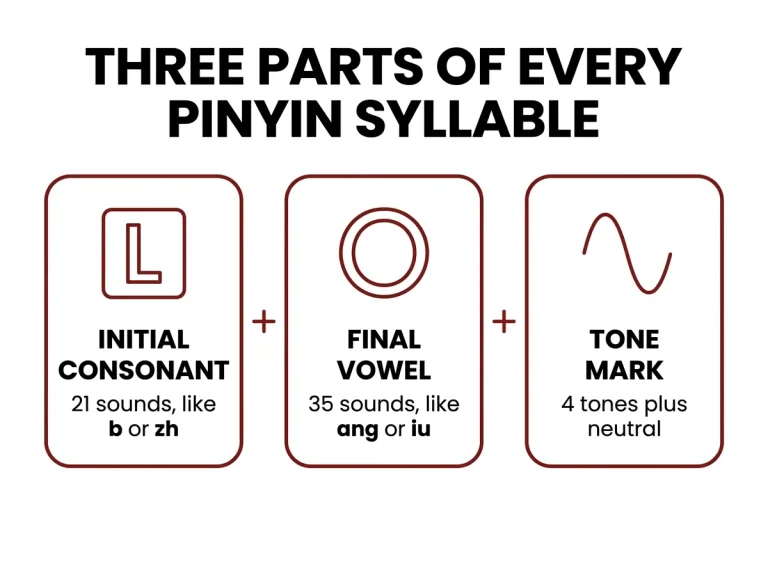
The Pinyin system is the official romanization standard for Mandarin Chinese. It was developed by linguist Zhou Youguang and adopted by the Ministry of Education of the People’s Republic of China in 1958. Pinyin uses 21 consonant initials and 35 vowel finals to represent every syllable in standard Mandarin. Learning its rules gives any English speaker a reliable method to pronounce Chinese names with confidence.
San Duanmu, Professor of Linguistics at the University of Michigan, confirmed in The Phonology of Standard Chinese (2007, Oxford University Press) that Mandarin operates on a syllable-timed rhythm. Every syllable carries equal weight. No syllable is reduced or swallowed the way English reduces unstressed syllables. This single property changes how English speakers must approach the pronunciation of Chinese names.
Table of Contents
ToggleWhat Is the Pinyin System and How Does It Work?
Pinyin is a romanization system that maps every Mandarin syllable to a Latin alphabet spelling with tone diacritics. It follows pronunciation conventions that are different from English spelling. Latin letters in Pinyin represent Mandarin sounds, not English sounds. Understanding this distinction significantly improves pronunciation accuracy for English speakers.
The Pinyin system contains 21 initials and 35 finals. Initials are the consonant sounds that begin a syllable. Finals are the vowel or vowel-plus-nasal combinations that complete it. The syllable “Ming” (明, bright) breaks into the initial M and the final -ing. The syllable “Zhi” (智, wisdom) breaks into the initial Zh and the final -i.
Jerry Norman, Professor of East Asian Languages at the University of Washington, documented in Chinese (Cambridge Language Surveys, 1988) that Pinyin achieved rapid international adoption after ISO 7098 standardized it in 1982. The International Organization for Standardization reaffirmed this standard as ISO 7098:2015. All official Chinese government documents, passports, and international publications use Pinyin as the sole romanization standard.
Zhou Youguang finalized the Pinyin framework at age 29. He worked as a linguistics researcher at what would later become the Chinese Academy of Sciences. He later described the work as a three-year effort to resolve centuries of competing proposals for romanization. His system replaced older systems, including Wade-Giles and Gwoyeu Romatzyh, in all official contexts. One practical point deserves emphasis. Pinyin is a pronunciation tool, not a spelling system.
How Do the Four Tones of Mandarin Work?
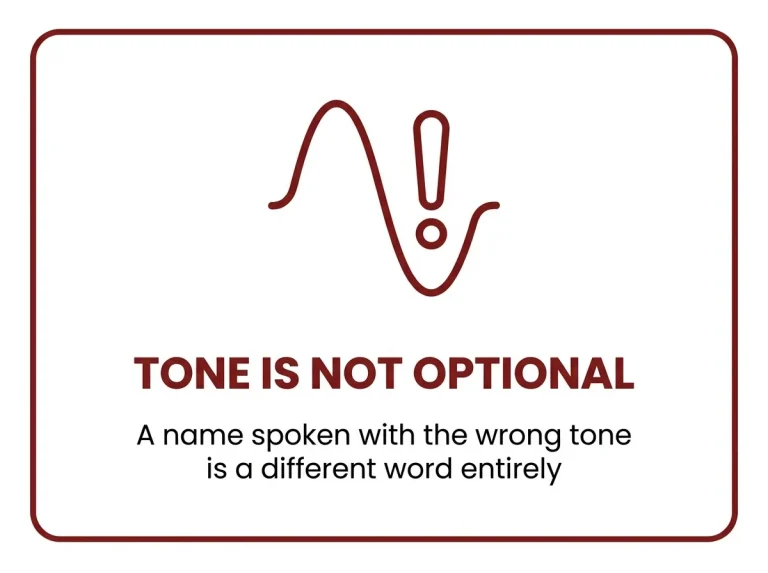
Mandarin uses four tones plus one neutral tone. Every syllable in a Chinese name carries one of these tones. The tone is not an accent or emphasis pattern. It is a fixed pitch contour that is part of the word itself.
The table below presents all five tones with their pitch contours, Pinyin diacritic marks, and example name characters.
| Tone | Number | Pitch Contour | Diacritic | Example |
|---|---|---|---|---|
| First | 1 | High and level | ā | Fāng 芳 |
| Second | 2 | Rising mid to high | á | Háo 浩 |
| Third | 3 | Low dipping then rising | ǎ | Wǎng 王 |
| Fourth | 4 | Sharp falling high to low | à | Wèi 卫 |
| Neutral | 0 | Short, light, no fixed pitch | a (no mark) | -de, -ma |
The first tone stays flat at the highest pitch. Imagine a sustained musical note. Second tone rises like a spoken question at the end. The third tone dips low and then rises; it often stays low without fully rising. The fourth tone falls sharply, like a firm command.
San Duanmu confirmed in his 2007 phonology research that the third tone in natural connected speech rarely reaches its full low-dip-rise contour. In flowing speech, most third tones are produced as low, flat tones. The full rising contour appears mainly when the syllable is spoken in isolation or with deliberate emphasis.
This matters for the pronunciation of Chinese names in real conversation. A name like Měi (美, beautiful) spoken in a sentence will typically sound low and flat rather than dipping and rising. Recognizing natural tone variation helps listeners identify tones more effectively in conversation.
What Is Tone Sandhi and Why Does It Matter?
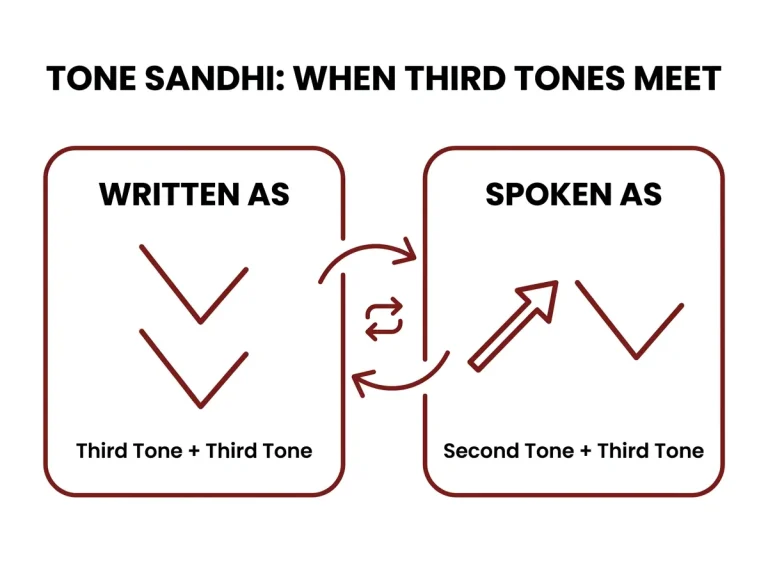
Tone sandhi is the rule governing how tones change in sequence. The most important sandhi rule in Mandarin involves consecutive third tones. A third tone is spoken immediately before another third tone rises to a second tone. It changes to a second-tone pronunciation in this context.
The name Lǐ Xiǎo (李晓) contains two third tones in sequence. In natural speech, Li rises to the second tone while Xiao retains the third tone. The spoken form is naturally pronounced as Lí Xiǎo. This change is automatic and consistent in all native speech.
John DeFrancis of the University of Hawaii documented this rule in The Chinese Language: Fact and Fantasy (1984). He noted that learners who ignore sandhi rules produce grammatically correct but rhythmically foreign speech. Applying sandhi rules is therefore essential for pronouncing Chinese names convincingly in connected speech.
What Are Tone Marks and Where Do They Sit?
Tone marks sit above the main vowel of each syllable. Identifying the main vowel requires knowing one rule. When a syllable contains only one vowel, the mark sits on that vowel. When a syllable contains two or more vowels, the mark follows a fixed priority order.
The priority order for tone mark placement is: a and e always take the mark first. O takes the mark when no a or e is present. In the finals -ui and -iu, the mark sits on the last vowel. This rule resolves every placement question in the Pinyin system without exception.
Practical examples from real Chinese names show this clearly. In Wáng (王), the mark sits on a, the only vowel present. In Méi (美), the mark sits on e, which takes priority over i. In Liú (刘), the mark sits on u, the last vowel in the -iu final.
There are no exceptions to these rules in standard Pinyin.
Tone marks appear in textbooks and dictionaries. They do not appear in most romanizations of Chinese names in passports, business cards, or on online platforms. The name Zhang Wei appears without tone marks in most international documents. Because tone marks are often omitted, audio references provide valuable guidance for determining the intended tone. Audio verification, therefore, becomes essential for any name without diacritics.
How Do You Pronounce the Notorious X, ZH, and Q Sounds?
These three sounds typically require the most focused practice for English speakers. Each has a precise articulation position with no direct English equivalent.
How Do You Produce the X Sound?
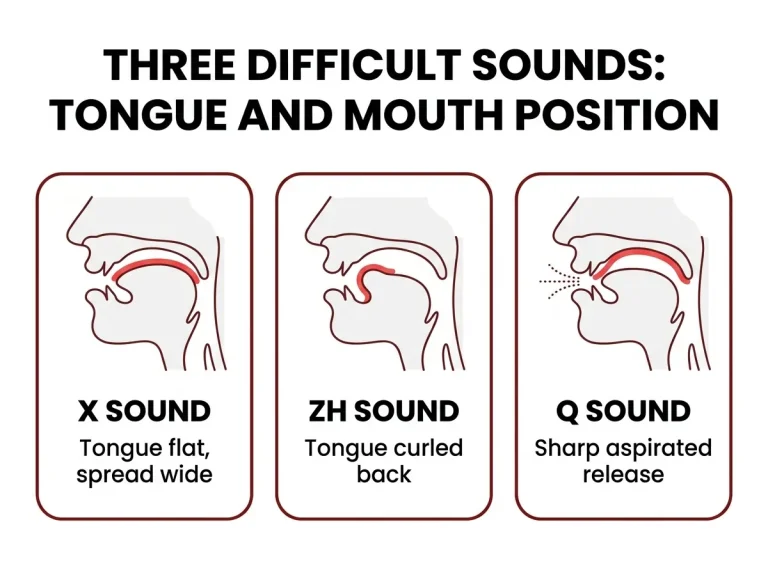
The x sound in Pinyin is a palatal fricative. Place the tongue blade near the hard palate. Spread your lips as if smiling. Blow air through the narrow channel between the tongue and the palate. The result sounds like a soft hiss somewhere between English “sh” and a long “ssss” with spread lips.
The x sound always pairs with the palatal vowels i and ü in Pinyin. It never appears before a, o, or u. Names containing x include Xi ( as in Xi Jinping), Xiǎo ( small), and Xīn ( heart). Practice the x sound by starting with a long “sssss” and then raising the tongue blade slightly toward the palate while keeping the lips spread.
How Do You Produce the ZH Sound?
The zh sound is a retroflex affricate. Curl the tip of the tongue upward and backward toward the hard palate without touching it. Produce a “j”-like sound from that curled position. The result resembles the “j” in “judge” but with the tongue curled further back than any English sound requires.
Names containing zh include Zhāng ( the third most common Chinese surname), Zhū ( red or surname Zhu), and Zhège. The curl of the tongue is the defining feature. Using the retroflex curl helps create a pronunciation that is closer to native Mandarin speech.
How Do You Produce the Q Sound?
The q sound is an aspirated palatal affricate. Position the tongue blade at the hard palate in the same position used for x. Add a strong burst of breath and release it as a “ch”-like sound with spread lips. The lips stay spread throughout the q sound. They stay flat and spread throughout the entire sound.
Names containing q include Qiáng (strong), Qīng (clear), and Qín (the Qin Dynasty surname). English speakers who substitute “ch” without spreading the lips and raising the palate produce a sound noticeably different from native Mandarin. The lip spreading distinguishes q from both English “ch” and Pinyin “ch” entirely.
How Do You Pronounce the R, C, Z, and J Sounds?
How Does the R Sound Work in Pinyin?
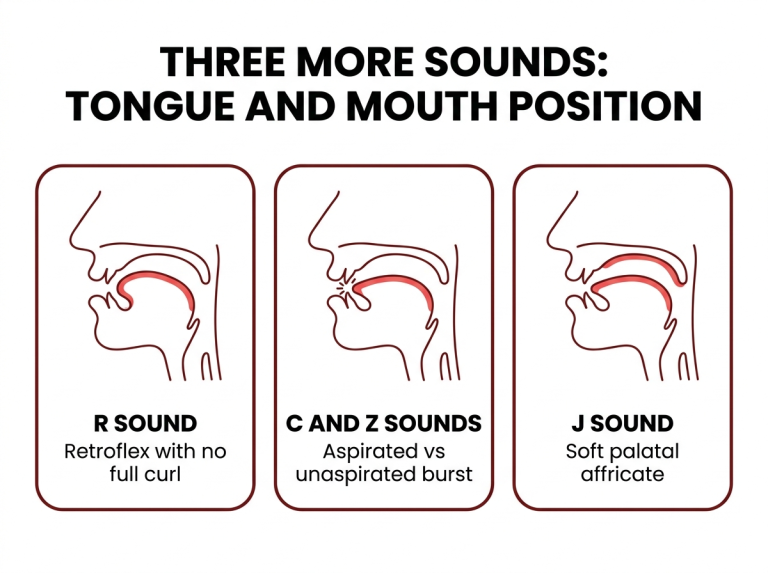
The Pinyin r sound is a unique Mandarin sound with its own articulation pattern. It is a retroflex approximant. Begin with the tongue position used for zh. Relax the tongue slightly so that no complete closure forms. Produce a voiced sound from that relaxed retroflex position. The result sounds like a blend of English “r” and “zh,” with a slight “y” coloring.
Names with r include Rén (仁, benevolence), Ruì (瑞, auspicious), and Róng (荣, glory). English speakers who substitute a standard American “r” produce a noticeable approximation. The retroflex position is essential. Practice by producing “zh” and then relaxing the tongue contact slightly until voicing continues without a stop.
How Do C and Z Work?
C is an aspirated dental affricate equivalent to “ts” with a strong breath release. It sounds like the “ts” in “cats” but with more aspiration. Z is the unaspirated version, “dz” without breath release.
The distinction between aspirated and unaspirated pairs is critical throughout Pinyin.
Names with c include Cáo (曹, the Three Kingdoms surname Cao), Cén (岑, a literary surname), and Cùn (寸, inch, used in some given names). Names with z include Zé (泽, to enrich, as in Mao Zedong’s given name), Zǐ (子, son or scholar), and Zēng (曾, a common surname).
How Does the J Sound Work?
The j in Pinyin is a palatal affricate without retroflex curl. It is produced at the same tongue position as q and x, but without aspiration. J sounds like the “jee” in “jeep,” with the lips spread and no breath burst. It never sounds like the French “j” or English “zh.” Names containing j include Jiāng (江, river), Jùn (俊, handsome and talented), and Jìng (静, serene).
Which Pinyin Vowel Combinations Mislead English Speakers Most?
Six Pinyin vowel finals benefit from additional attention when learning pronunciation. Each follows a specific rule with no exceptions. The table below presents the six most commonly mispronounced Pinyin finals with their correct and incorrect pronunciations.
| Pinyin Final | Wrong Pronunciation | Correct Pronunciation | Example Name |
|---|---|---|---|
| -ian | ✗ "ee-an" | ✓ "yen" | Jiàn (建) |
| -ui | ✗ "oo-ee" | ✓ "way" | Ruì (瑞) |
| -iu | ✗ "ee-oo" | ✓ "yo" | Liú (刘) |
| -ong | ✗ "ong" as in "Song" | ✓ "oong" — rounded o | Hóng (红) |
| -eng | ✗ "eng" as in "length" | ✓ "ung" — as in "sung" | Héng (衡) |
| -un | ✗ "un" as in "fun" | ✓ "wen" — rounded vowel | Lún (伦) |
The -ian final deserves special attention. It appears in extremely common Chinese name characters, including Jiàn (建, to build), Xiān (先, first), and Lián (莲, lotus). English speakers reading -ian as “ee-an” produce a two-syllable sound where Mandarin produces one compact “yen” syllable. Every occurrence of -ian in a Chinese name is pronounced “yen.” The -ong final uses a rounded vowel quality that differs from the vowel heard in English “Song.” Mandarin -ong uses a rounded vowel closer to “oong.” Names like Hóng (红, red), Lóng (龙, dragon), and Chóng (重, layered) all require this rounded vowel quality throughout.
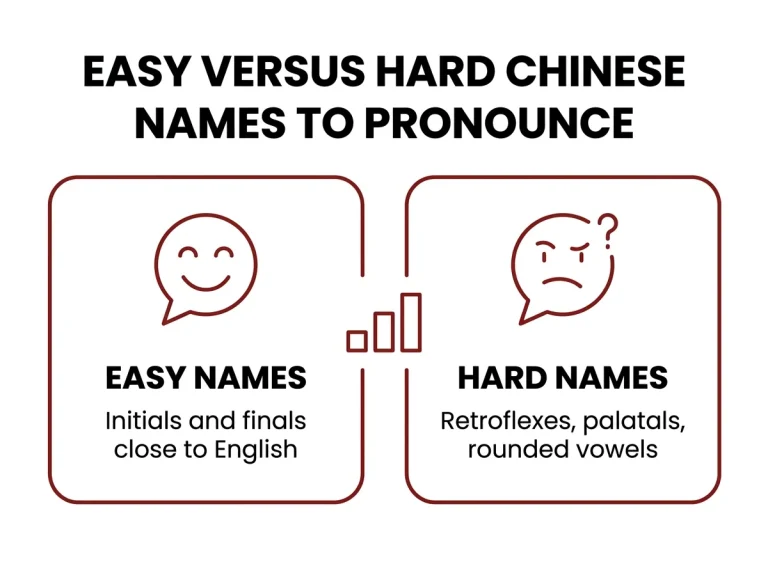
What Are Easy Chinese Names to Pronounce?
Easy Chinese names use initials and finals that map closely to English sounds. They carry no retroflex consonants, no palatal affricates, and no misleading vowel combinations.
Names in this category include Mèi (美, beautiful), Fāng (芳, fragrant), Hào (浩, vast), Míng (明, bright), Wén (文, literary), and Lán (兰, orchid). Each uses consonants familiar to English speakers. Their vowels match their written appearance closely enough that an English speaker reading them produces an acceptable approximation on the first attempt.
The surname Lǐ (李) presents one moderate challenge. The initial L is familiar. The final -i after a retroflex or dental initial becomes a special vowel with no English equivalent, a syllabic buzzing sound rather than the “ee” of standard -i. But in most connected speech, English speakers who produce a short “ee” will be understood without confusion.
What makes this interesting is that easy Chinese names are easy specifically because they avoid the retroflex and palatal consonant groups entirely. They cluster in the bilabial (m, b, p), labiodental (f), alveolar (n, l), and simple dental (d, t) categories. Families and individuals whose names fall in these categories present the lowest pronunciation barrier for English speakers encountering Chinese names for the first time.
What Are Hard Chinese Names to Pronounce?
Advanced Chinese names often combine retroflex consonants, palatal affricates, and specialized vowel finals. They require deliberate practice and cannot be approximated from spelling alone.
Names in the hardest category include Zhūgě (诸葛, the compound surname), Xuě (雪, snow), Qiáng (强, strong), Ruì (瑞, auspicious), and Zhèng (郑, a common surname). Each includes at least one sound that is unique to Mandarin pronunciation.
Zhūgě combines the retroflex zh with the distinctive ü vowel in gě. The ü vowel requires rounded lips held in an “oo” position while the tongue produces an “ee” sound. No English word contains this vowel. The French “u” or German “ü” serves as the closest available reference sounds for English speakers with European-language exposure.
The surname Xiè (谢, a common surname meaning “gratitude”) pairs the palatal x with the misleading -i.e., final. The -i.e., final is pronounced “yeh”, not “ee-ay.” Xiè therefore sounds like “shyeh” with the x spread, rather than any English “sh” equivalent.
The phonetic pronunciation of Chinese names in this hard category requires three steps. First, identify each initial and produce it correctly in isolation. Second, identify the final and apply its correct vowel rule. Third, add the correct tone over the combined syllable. Following all three steps helps achieve an accurate pronunciation.
What Is the One Rule That Changes Everything?
The single most important rule in Chinese name pronunciation is this. Pinyin letters represent Mandarin sounds using the Latin alphabet. They are labels for Mandarin sounds that happen to use the same alphabet.
Nearly all pronunciation challenges discussed in this guide share the same underlying principle. An English speaker sees the letter x and produces an English x. An English speaker sees zh and produces an English z followed by h. An English speaker sees q and produces an English “kw” sound. These letter-sound relationships are specific to Pinyin and Mandarin pronunciation.
What remains unresolved in pronunciation research is measurable. How much retroflex precision does a non-native speaker require before a native Mandarin listener perceives the name as correctly pronounced? Current phonetics research has not produced a single agreed threshold. San Duanmu’s 2007 research established that tonal accuracy matters more to intelligibility than consonant precision. But the exact retroflex accuracy threshold remains unstudied at the level of individual names.
Apply the rules in this guide as a foundation. Use Forvo audio references as verification. Prioritize tone accuracy above consonant precision. A correctly toned name with an imprecise zh will be understood. Accurate tones help ensure that the intended word is understood clearly.
Frequently Asked Questions
What is Pinyin, and why does it matter for pronouncing Chinese names?
Pinyin is the official romanization system for Mandarin Chinese, developed by linguist Zhou Youguang and adopted by China's Ministry of Education in 1958. It uses 21 consonant initials and 35 vowel finals to represent every syllable in standard Mandarin. Pinyin letters are labels for Mandarin sounds, not English sounds. This is the most important distinction for any English speaker attempting to pronounce Chinese names.
How many tones does Mandarin Chinese have?
Mandarin has four tones plus one neutral tone. The first tone is high and level. The second tone rises from mid to high pitch. The third tone dips low and then rises. The fourth tone falls sharply from high to low. The neutral tone is short, light, and carries no fixed pitch. Every syllable in a Chinese name carries one of these tones, and the tone is a fixed part of the word itself, not an accent or emphasis pattern.
What is tone sandhi, and how does it affect Chinese name pronunciation?
Tone sandhi is the rule governing how tones change in sequence. The most important rule in Mandarin states that a third tone is spoken immediately before another third tone rises to a second tone. For example, the name Lǐ Xiǎo (李晓) contains two consecutive third tones. In natural speech, Li rises to the second tone while Xiao keeps the third tone. The spoken result sounds like Lí Xiǎo. Ignoring sandhi rules produces grammatically correct but rhythmically foreign speech.
How do you pronounce the x sound in Chinese names?
The Pinyin x is a palatal fricative with no direct English equivalent. Place the tongue blade near the hard palate, spread the lips as if smiling, and blow air through the narrow channel between the tongue and palate. The result sounds like a soft hiss between English "sh" and a long "ssss" with spread lips. The x sound always pairs with the palatal vowels i and ü. It appears in names such as Xi, Xiǎo (small), and Xīn (heart).
How do you pronounce the zh sound in Chinese names?
The zh sound is a retroflex affricate. Curl the tip of the tongue upward and backward toward the hard palate without touching it, then produce a "j"-like sound from that curled position. The result resembles the "j" in "judge" but with the tongue curled further back than any English sound requires. Names containing zh include Zhāng (张), Zhū (朱), and Zhège. Using the retroflex curl creates a pronunciation that more closely matches standard Mandarin speech.
How do you pronounce the q sound in Chinese names?
The Pinyin q is an aspirated palatal affricate. Position the tongue blade at the hard palate in the same position used for x, add a strong burst of breath, and release it as a "ch"-like sound with spread lips. The q sound is produced with the lips held in a spread position throughout articulation. They stay flat and spread throughout. Names containing q include Qiáng (强), Qīng (清), and Qín (秦). Substituting the English "ch" without spreading the lips produces a sound noticeably different from native Mandarin.
Which Pinyin vowel combinations mislead English speakers most?
Six Pinyin vowel finals benefit from focused pronunciation practice. The -ian final is pronounced "yen," not "ee-an." The -ui final is pronounced "way," not "oo-ee." The -iu final is pronounced "yo," not "ee-oo." The -ong final uses a rounded vowel closer to "oong," not the unrounded vowel in English "Song." The -eng final sounds like "ung" as in "sung," not "eng" as in "length." The -un final is pronounced "wen" with a rounded vowel, not "un" as in "fun."
Where do tone marks sit in Pinyin spelling?
Tone marks sit above the main vowel of each syllable. When a syllable contains only one vowel, the mark sits on that vowel. When two or more vowels appear, a fixed priority order applies. The vowels a and e always take the mark first. The vowel o takes the mark when no a or e is present. In the finals -ui and -iu, the mark sits on the last vowel. These rules resolve every placement question in the Pinyin system without exception.
Why are Chinese names in passports and business cards commonly written without tone marks?
Tone marks appear in textbooks and dictionaries but are omitted from most romanizations of Chinese names in passports, business cards, and online platforms. Without tone marks, audio references are often the most reliable way to identify the intended tone. For example, Zhang Wei appears without tone marks in most international documents. Audio verification becomes essential for any name presented without diacritics.
Is tone accuracy or consonant accuracy more important when pronouncing Chinese names?
Tone accuracy matters more to intelligibility than consonant precision. San Duanmu of the University of Michigan confirmed this finding in The Phonology of Standard Chinese (2007, Oxford University Press). A correctly toned name with an imprecise zh will be understood by native listeners. Even with accurate consonants, correct tones are essential for conveying the intended word. Prioritizing tone accuracy above consonant precision gives the fastest practical improvement in Chinese name pronunciation.
How does the Pinyin r sound differ from the English r?
The Pinyin r is a retroflex approximant with no English equivalent. It begins from the tongue position used for zh, but the tongue relaxes so that no complete closure forms. The result sounds like a blend of English "r" and "zh" with a slight "y" coloring. Names with r include Rén (仁, benevolence), Ruì (瑞, auspicious), and Róng (荣, glory). Substituting a standard American "r" produces a noticeable approximation. Practice by producing "zh" and then relaxing the tongue contact until voicing continues without a stop.
How do I pronounce my name in Chinese?
To pronounce your name in Chinese, first find its Chinese characters and corresponding Pinyin spelling with tone marks. Then pronounce each syllable according to Pinyin rules and use the correct tones, verifying the pronunciation with native-speaker audio whenever possible.