
Chinese name generator
An interactive Chinese Name Generator that creates random names with meanings, pronunciation, and cultural details, along with features like voice playback, lucky elements, and a modern animated UI.
It also allows users to filter names by gender and easily copy or listen to the generated name.
Validated against the Kangxi Dictionary (1716)
Peer-reviewed onomastics research
Three verification stages per character
Five-grid framework
Table of Contents
ToggleAuthentic Chinese Names With Cultural Meaning
Finding a Chinese name that carries genuine cultural weight is harder than most people expect. Meanings are absent, inaccurate, or stripped of the cultural context that makes a name real. Most online sources return character lists with no tonal data, no elemental classification, and no verified naming history behind each result. A name selected without these verified dimensions carries cultural risk that the bearer carries for life.
This Chinese name generator solves that gap by combining seven verified data points into every single result. These are the Chinese characters, pinyin romanization, stroke count, elemental tag, lucky number, lucky color, and name harmony score. According to Hung-Lin Tao at Soochow University, 43% of Taiwanese adults believe in stroke-count numerology when naming a child. The sāncái wǔgé (三才五格) five-grid framework governs the stroke count calculation behind every harmony rating produced by this tool. The Wuxing five-element system (五行, Wǔxíng) governs the elemental tag assigned to every result.
It was developed with reference to classical Chinese naming texts and peer-reviewed linguistic research. Cultural data points were validated against the Kangxi Dictionary (康熙字典), the Hundred Family Surnames (百家姓), and published onomastics research in Chinese personal naming systems. Every character in the generation database was cross-referenced against historical naming registries before inclusion. No character enters the generation pool without passing all three verification stages.
How Does This Chinese Name Generator Work?
This tool creates authentic Chinese personal names by combining culturally verified characters with meaning, phonetic data, elemental classification, and gender attributes. It selects characters based on tonal balance, stroke harmony, elemental compatibility, meaning coherence, and cultural auspiciousness. Three distinct generation modes serve different user needs.
Random mode draws a culturally neutral name from the full character database. The male category (男) produces names carrying attributes traditionally associated with strength, virtue, or scholarly achievement. The female category (女)produces names associated with grace, beauty, natural imagery, or auspicious femininity.
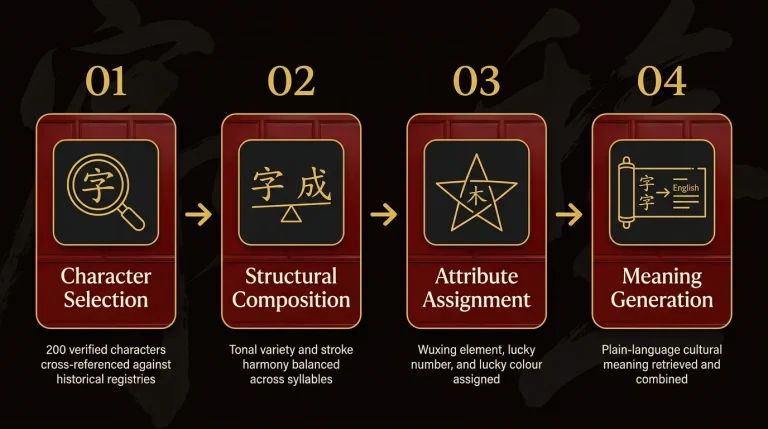
How Does Character Selection Work?
Every character in this database was cross-referenced against historical naming registries. These include the Hundred Family Surnames (百家姓), Tang and Song dynasty genealogical records, and documented modern naming data. No character enters the generation pool without passing all three verification stages.
How Does Structural Composition Work?
Chinese families maintained internal naming taboos across generations. A child could not receive a name containing any character from the name of a living or deceased ancestor within the direct patrilineal line. Ancestral taboos prevented confusion within multigenerational households.
How Does Attribute Assignment Work?
The tool calculates the name's lucky number through Chinese numerological methods. It assigns an elemental category from the Wuxing five-element system: Wood (木), Fire (火), Earth (土), Metal (金), and Water (水). Each element carries a lucky color that appears on the result card.
How Does Meaning Generation Work?
The tool retrieves the verified cultural meaning of each character and combines them into a plain-language description. For example, the Chinese name 瑞麟 (Ruì Lín) means "auspicious unicorn." Chinese given names encode moral aspirations, and transmit clan identity.
What Cultural Data Does Each Generated Name Include?
Every result this tool generates carries seven distinct data points on a single result card. The seven cultural data points are the Chinese characters, the stroke count per character, the pinyin romanization with tones, the name meaning in plain language, the gender classification, the elemental tag, and the lucky number.
Elemental Tag
The name' Wuxing element classification' appears on every result card. Earth element (土) names carry associations with stability, endurance, and grounded character. This aligns with the ochre lucky color displayed alongside Earth-classified names on every result card.
Gender Classification
Every name carries a gender tag: male (男) or female (女). Research published in the Journal of Chinese Linguistics identifies three primary mechanisms of gender marking in Chinese given names. Radical composition signals gender through components like 女 (nǚ, feminine) or 力 (lì, strength, masculine).
Name Meaning Section
Every result includes the complete cultural meaning expressed in plain English. The meaning identifies the specific imagery invoked by the characters. It is never a generic description. The name 瑞麟 (Ruì Lín) produces "auspicious unicorn" because 麟 refers specifically to the Qilin.
Pinyin Romanization
The tool displays the complete pinyin romanization. Pinyin (拼音, Pīnyīn) is the official romanization system standardized in 1958 by the People's Republic of China. It preserves tonal information through diacritic markers that no standard Latin alphabet spelling system provides.
Stroke Count
Numerological traditions assign significance to the total stroke count of a complete name. Stroke count system is used to evaluate five dimensions of fortune. A name with an inauspicious total grid score creates discomfort for culturally informed Chinese readers.
Chinese Characters
The name appears in full Chinese script at high resolution. Users can read, study, or reproduce every character accurately. Traditional Chinese script is the default display format. This is the script used in Taiwan, Hong Kong, Macau, and by many overseas Chinese communities worldwide.
What Is Name Harmony and Why Does It Matter?
Name harmony (名字和谐度, míngzì héxié dù) is the measure of balance between the characters forming a Chinese given name. The rating reflects three dimensions simultaneously. Phonetic harmony, stroke symmetry, and radical compatibility together define whether a name succeeds or fails by the standards of the Chinese naming system.
Stroke symmetry measures whether the stroke counts of the characters create visual and energetic balance when the name is written. Tonal mellifluousness (音调悦耳) measures whether the tones create a pleasing phonetic sequence. Similarly, character radical compatibility measures whether the semantic roots of the combined characters reinforce.
Five-star names represent the rarest combination. Perfect stroke symmetry, ideal tonal sequence, and complete semantic reinforcement between characters must all occur together. A name with a two-star harmony score may be phonetically valid but structurally imbalanced in ways that educated Chinese readers.
What Are Lucky Numbers in Chinese Names?
Lucky numbers are elemental attributes assigned to a Chinese name based on its Wuxing classification and numerological profile. These are documented components of the Chinese naming consultation tradition, practiced continuously for over 2,000 years. The auspicious stroke number system draws its authority from both Taoist cosmology and Confucian moral philosophy.
Chinese numerology assigns positive and negative associations to each number based on phonetic similarity to auspicious or inauspicious Mandarin words. The number 8 (bā, 八) carries the strongest positive resonance because of its phonetic similarity to prosperity (fā, 发). The number 4 (sì, 四) is traditionally avoided in name and address selection because of its phonetic similarity to death (sǐ, 死).
Numbers classified as broadly auspicious include 1, 3, 5, 6, 8, 11, 13, 15, 16, 17, 18, 21, 23, 24, 31, 32, 37, and 41. Numbers carrying inauspicious associations include 4, 9, 10, 12, 14, 19, 20, 22, 26, 27, 34, and 44. These classifications appear in the most widely used stroke count numerology references across mainland China, Taiwan, and Hong Kong.
How Does the Chinese Name Pronunciation Feature Work?
Chinese is a tonal language. A written pinyin romanization tells a user what sounds to produce, but it does not teach confident production of those sounds. Chinese name culture treats correct tonal pronunciation as a mark of genuine respect toward the name's bearer.
A name containing Wēi (威, authority, first tone) mispronounced as Wèi (喂, feeding or calling out, fourth tone) shifts from a name signaling strength to one associated with a casual street call. That shift happens in a single syllable, and a native speaker notices it immediately.
The Mandarin tonal system governs every aspect of personal name selection, from how characters sound together to how a name travels across different regional accents. This tool provides three options for pronouncing each result's Chinese name.
What Is the English Accent Option?
This option speaks the name using English-language phonetic conventions applied to the pinyin spelling. It is designed for English speakers who need to pronounce the name so their audience will recognize it. Use this version when introducing the name in a primarily English-speaking context.
What Is the Mandarin Accent Option?
This option (普通话, pǔtōnghuà) renders the name in native Mandarin pronunciation with correct tonal inflection. Practice this version when planning to introduce the Chinese name directly to Mandarin speakers. Tonal accuracy signals genuine cultural respect.
What Does the Both Accents Option Do?
This option renders the name first in English, then immediately in Mandarin. The bilingual sequence allows a user to hear the contrast between both pronunciations. A user understands how the name travels across linguistic contexts.
Who Uses a Chinese Name Generator Online?
Seven distinct groups use this tool for seven distinct purposes.
Adoptive Families: Parents who adopt children from China frequently seek an authentic Chinese name to create a cultural connection. This tool provides a name with meaning, pronunciation, and cultural attributes that parents can research and share with their child as that child grows.
Writers and Game Designers: Fiction authors, screenwriters, tabletop game designers, and video game developers use authentic Chinese names for characters. A name generated through this tool carries verifiable cultural meaning that enriches fictional worlds and satisfies culturally informed readers and players.
Mandarin Language Learners: Students in universities, language schools, and self-study programs need a Chinese name for class use and language exchange partners. The bilingual pronunciation audio feature allows them to hear correct tonal pronunciation before their first conversation.
Business Professionals Working With China: Foreign professionals building relationships with Chinese colleagues benefit from offering a Chinese name during introductions. In China, offering a Chinese name signals preparation and cultural awareness. That signal carries genuine professional weight.
Cultural Heritage Seekers: Members of the Chinese diaspora raised outside China and never given a Chinese name use this tool to reconnect with their heritage. The seven data points on every result card make the reconnection meaningful rather than superficial.
Performers and Artists: Singers, actors, martial artists, and visual artists working in Chinese cultural contexts adopt Chinese stage names. An inauthentic stage name is recognized immediately by Chinese-speaking audiences and damages professional credibility before a performance begins.
Researchers and Educators: Linguists, historians, and cultural educators use generated names as teaching examples. A name with documented stroke count, elemental classification, and tonal data provides students with a complete structural model that abstract explanations alone cannot.
What Are the Main Categories of Chinese Name Types?
Chinese given names fall into six culturally documented categories. Chinese family names, recorded systematically in the Hundred Family Surnames (百家姓, Bǎijiāxìng), the classical text compiled during the Song Dynasty, are passed down unchanged across generations. Chinese given names, by contrast, are chosen freshly for each individual within cultural and numerological constraints.
Virtue Names (德行名, Déxíng Míng)
Virtue names are used to select characters who express Confucian moral qualities. Benevolence (仁, rén), righteousness (义, yì), wisdom (智, zhì), trustworthiness (信, xìn), and propriety (礼, lǐ) are the five classical Confucian virtues most commonly appearing in Chinese given names.
Nature Names (自然名, Zìrán Míng)
Nature names draw characters from the natural world. Mountains, rivers, seasons, flowers, weather patterns, and celestial bodies provide the character vocabulary for this category. The character 梅 (méi, plum blossom) and 雪 (xuě, snow) are classic examples.
Aspiration Names (志向名, Zhìxiàng Míng)
Aspiration names express the family's hopes for the child's future. Characters meaning achievement (成, chéng), flourishing (荣, róng), prosperity (昌, chāng), and excellence (秀, xiù) belong to this category. These names function as lifelong declarations of family expectation written into identity itself.
Poetic Names (诗意名, Shīyì Míng)
Poetic names draw characters or character combinations from classical Chinese poetry, particularly Tang and Song dynasty verse. A poetic name carries a literary allusion that educated readers recognize.
Mythological Names (神话名, Shénhuà Míng)
Mythological names reference creatures, deities, or events from Chinese mythology. The name 瑞麟 (Ruì Lín) is mythological because 麟 refers to the Qilin (麒麟), the mythological creature of fortune and rare virtue.
Generational Names (字辈名, Zìbèi Míng)
Generational names incorporate the clan's assigned generational character (字辈, zìbèi) as the first character of the given name. The second character is chosen freely within cultural conventions.
What Do Chinese Names of Elements Mean?
The Wuxing system originated in Zhou Dynasty philosophical thought and was formalized as a classification structure during the Han Dynasty. Every character in the Chinese naming database carries an elemental association. Every name this tool generates receives a Wuxing five-element classification based on the dominant elemental properties of its characters.
The table below maps each of the five elements to its properties, lucky color, season, and character qualities.
| Element | Chinese | Lucky Color | Season | Character Qualities |
|---|---|---|---|---|
Wood |
木 (Mù) | Green | Spring | Growth, creativity, vitality, new beginnings |
Fire |
火 (Huǒ) | Red | Summer | Energy, passion, courage, dynamic expression |
Earth |
土 (Tǔ) | Ochre | Late Summer | Stability, nourishment, groundedness, endurance |
Metal |
金 (Jīn) | White / Gold | Autumn | Strength, discipline, precision, refinement |
Water |
水 (Shuǐ) | Black / Navy | Winter | Wisdom, adaptability, depth, flowing intelligence |
The Wuxing system served as the primary organizational structure for naming decisions throughout imperial China.
How Does the Generator Handle Gender?
Chinese name generators assign gender through character analysis, semantic category filtering, and frequency-pattern matching against documented name records. Research published in the Journal of Chinese Linguistics confirms three primary mechanisms of gender marking in Chinese given names.
The following table summarizes common gender associations in Chinese naming characters.
| Character | Pinyin | Meaning | Gender Convention |
|---|---|---|---|
芳 |
Fāng | Fragrant, virtuous | Female |
雪 |
Xuě | Snow | Female |
强 |
Qiáng | Strong, powerful | Male |
军 |
Jūn | Military, army | Male |
明 |
Míng | Bright, intelligent | Gender-neutral |
辉 |
Huī | Radiance, brilliance | Gender-neutral |
This table shows that gender in Chinese names operates on a spectrum. The pattern breaks down when characters like 明 (Míng) and 辉 (Huī) appear. These characters carry no dominant gender association and appear in verified male, female, and gender-neutral naming records with equal frequency.
What Is Stroke Count Numerology in Chinese Naming?
Stroke count numerology (姓名学, xìngmíng xué) organizes stroke count totals into five grids (三才五格, sāncái wǔgé). Each grid governs a different dimension of the name's influence on the bearer's life. All stroke counts in this system follow the Kangxi Dictionary, romanized as Kāngxī Zìdiǎn (康熙字典), the authoritative imperial reference compiled in 1716 during the Qing Dynasty. The Kangxi Dictionary remains the accepted standard for stroke-count grid calculation in authentic Chinese name selection today.
The Heaven Grid (天格, tiāngé) is calculated from the surname's stroke count plus one. The Person Grid (人格, réngé) is calculated from the stroke count of the surname's final character plus the given name's first character. The Earth Grid (地格, dìgé) is calculated from the given name's total stroke count plus one. The External Grid (外格, wàigé) represents social fortune. The Total Grid (总格, zǒnggé) is the sum of all characters in the full name.
Auspicious numbers include 1, 3, 5, 6, 8, 11, 13, 15, 16, 17, 18, 21, 23, 24, 31, 32, 37, and 41. Numbers carrying inauspicious associations include 4, 9, 10, 12, 14, 19, 20, 22, 26, 27, 34, and 44. Hung-Lin Tao at Soochow University confirmed a striking secondary pattern in the same research. Educational attainment is positively associated with the degree of luck assigned to Chinese name strokes. Parents with higher education apply stroke count frameworks more deliberately, not less.
What Common Mistakes Non-Chinese People Make When Choosing a Chinese Name?
Transliterating a Western name into Chinese characters produces a name that may be phonetically recognizable but semantically incoherent. These names may carry meanings that are inauspicious or grammatically misaligned in ways the user cannot detect without cultural knowledge.
Chinese characters with complex, visually impressive stroke structures are not necessarily appropriate for personal names. Visual complexity does not equal cultural appropriateness in the Chinese naming tradition.
Selecting characters without considering their tonal relationship produces a name that sounds awkward or monotonous when spoken aloud. Two identical tones in sequence are the most common tonal mistake among non-native name selectors.
What Makes a Chinese Name Authentic?
Authenticity in a Chinese name is the intersection of five distinct verifiable properties. Auspicious naming in Chinese culture requires all five properties to be present simultaneously. A name passing only three of five checks is not an authentic Chinese personal name by the standards this tool applies.
Structural Authenticity
The name follows the surname-first, given-name-second order. The given name consists of one or two characters appropriate for personal naming use. Every name this tool produces follows this structure without exception.
Phonetic Authenticity
The characters produce a pronounceable tonal sequence in Mandarin. Characters that create awkward tonal collisions are excluded from the generation database entirely before any result is shown.
Semantic Authenticity
The characters carry meaningful content that reinforces each other. A name whose characters contradict each other in meaning fails this standard. The characters must reinforce each other culturally and linguistically to pass the semantic filter.
What Are Naming Taboos in Chinese Culture?
Naming taboos (避讳, bìhuì) are prohibitions against using specific characters in personal names because those characters appear in the names of emperors, ancestors, or sacred figures. The bìhuì system operated as a formal legal constraint on Chinese naming for over two thousand years.
Imperial Taboo (国讳, Guójì)
Every Chinese emperor's personal name became forbidden for all subjects upon coronation. The emperor Taizong's personal name, Shimin (世民), made both characters unavailable to all subjects during the Tang Dynasty. This created waves of mandatory name changes across the population each time a new emperor ascended.
Ancestral Taboo (家讳, Jiājì)
Chinese families maintained internal naming taboos across generations. A child could not receive a name containing any character from the name of a living or deceased ancestor within the direct patrilineal line. Ancestral taboos prevented confusion within multigenerational households and preserved each generation's distinct identity.
Sacred Figure Taboo
Characters from the name Confucius, whose personal name was Qiu (丘), meaning hill or mound, were avoided in personal naming across imperial China out of reverence. Writers substituted alternative characters in official documents to avoid any association with the sacred name.
The 2012 Ministry of Public Security directive on name registration prohibited characters that standard government computer systems cannot process. This directive affects thousands of characters outside the standard government processing set, effectively limiting personal name registration to characters compatible with national identity systems.
How Do Chinese Tones Work in a Name?
Mandarin Chinese uses four tones and one neutral tone to assign distinct meanings to syllables that are spelled identically in pinyin. Tone is not an accent variation. Tone is a grammatical feature that changes meaning as fundamentally as a different letter changes meaning in English. The tonal pattern of a name is as much a part of its name structure as the characters themselves.
The first tone (ā) is high and flat. The voice maintains a high, steady pitch throughout the syllable. The syllable mā (妈) means mother in the first tone. The second tone (á) is rising. The second tone rises from mid pitch to high pitch. The syllable má (麻) means hemp or numb.
The third tone (ǎ) is dipping. The voice falls from mid to low pitch, then rises. The syllable mǎ (马) means horse in the third tone. The fourth tone (à) falls sharply. The voice drops quickly from high to low. The syllable mà (骂) means to scold in the fourth tone.
Frequently Asked Questions
Can I Use a Generated Chinese Name as My Official Name?
Yes, in most jurisdictions where Chinese names can be registered. Many countries permit legal name registration in Chinese characters, including the United States, Canada, Australia, the United Kingdom, and Singapore. Every name generated follows all structural and phonetic conventions required for name use in mainland China, Taiwan, Hong Kong, and Singapore.
Do I Need to Know Chinese to Use This Tool?
No. The tool generates every name with its English-language meaning, pinyin romanization, and pronunciation audio. A user with no Mandarin knowledge can generate, understand, and pronounce a complete Chinese name from the very first result.
Does Character Rarity Affect Name Quality in Chinese Naming Tradition?
Yes. Rare characters carry stronger cultural distinctions but require careful verification. Common naming characters like 明 (Míng) appear in millions of registered names and have well-documented meanings. This tool draws exclusively from characters with verified naming histories, balancing cultural distinction with practical usability.
Do Generated Chinese Names Follow the Same Rules Native Families Apply?
Yes. Native Chinese families apply five consistent criteria when selecting a given name. These are tonal compatibility between characters, stroke-count harmony across the full name, elemental alignment with the child's birth data, semantic reinforcement between character meanings, and the absence of taboo characters from ancestral or imperial registers. Every name generated by this tool passes all five criteria before appearing in the results.
Why Do Fictional Chinese Names Require the Same Cultural Standards as Real Names?
Culturally informed readers identify inauthenticity in fictional Chinese names. A fictional character named with phonetically transliterated characters that carry inauspicious meanings or tonal collisions signals cultural unfamiliarity to any native reader. The Tang and Song dynasty literary tradition established that a character's name encodes their moral identity, social standing, and fate simultaneously. Fictional names that ignore these conventions break the cultural credibility of the entire work for Chinese-speaking audiences.
How Does the Tool Handle Traditional Versus Simplified Chinese Characters?
The tool displays names in Traditional Chinese script. This is the script used in Taiwan, Hong Kong, Macau, and by many overseas Chinese communities worldwide.
Can I Generate a Name for Someone Born Under a Specific Chinese Zodiac Sign?
Yes. Generate names in the element mode corresponding to your zodiac sign's elemental association. The Rat, Ox, Tiger, Rabbit, Dragon, Snake, Horse, Goat, Monkey, Rooster, Dog, and Pig each have specific Wuxing elemental associations in Chinese astrology. The elemental tag on every result card identifies which of the five Wuxing elements governs that name, making zodiac-based selection direct and verifiable.